By Sumaya Ali
Translated by Hussein Moghniyeh
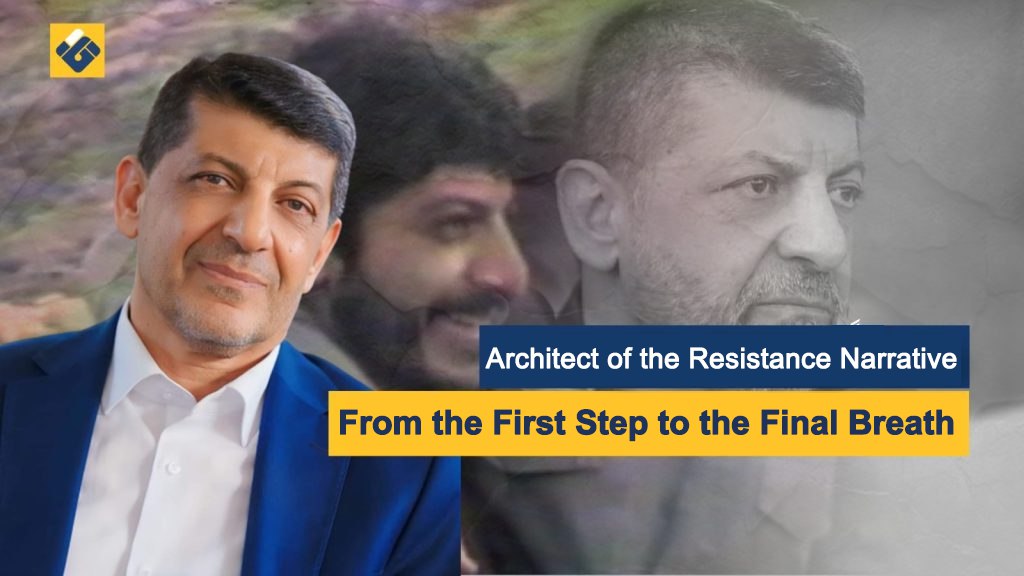
Hajj Mohammad Afif lived resistance as a creed, a discipline, and a destiny. His life—spanning four decades or more—unfolds as the story of a revolutionary who first carried the rifle in the field and later mastered the sharp weapons of media warfare. He became a founding pillar of the resistance’s media identity and a steadfast believer that confronting the enemy’s arrogance could only be done through Islamic resistance, in all its forms.
For Hajj Afif, there was no alternative path—not in the illusions of political surrender nor in the false salvation sought through international resolutions. His life’s compass never deviated from the certainty that resistance must be comprehensive: military, political, cultural, economic, social, and above all, informative. His lifelong companion from youth, Hajj Abdullah Qasir—the assistant to the head of Hezbollah’s Executive Council—summed it succinctly after Hajj Afif’s martyrdom on November 17, 2024, in an Israeli airstrike that killed him and four comrades while they were engaged in media work in Beirut’s Ras al-Nabaa: “The caravans of martyrs forge victory.”
His martyrdom, which granted him what he had longed for since the heartbreaking loss of Secretary-General Sayyed Hassan Nasrallah, invites a question: Was Hajj Afif’s resistance only a legacy of the past? His own words provide the answer. Standing defiantly amid the rubble of Beirut’s southern suburbs, he praised the courage of the frontline fighters who prevented the enemy from occupying even a single village, insisting: “The resistance is a nation—and a nation does not die.”
A year after his martyrdom, he remains present. His conviction in the power of steadfastness, the strategic value of words and images, and the necessity of ingenuity shaped a media vision that helped define how the Islamic resistance addressed its adversaries, its allies, and its own people. From the earliest days of Hezbollah’s founding, Hajj Afif served with unwavering dedication, carrying responsibilities with both intellect and heart. Only fragments of his immense labor have ever been spoken of publicly.
The Resistance’s Media Engineer—From the First Hour to the Last Breath
“From the depths of sorrow I came, to close the doors of the defeated and to herald humanity.”
These verses by Iraqi poet Muzaffar al-Nawâb—whose revolutionary works Hajj Afif memorized—capture the essence of his final months during the latest Israeli aggression on Lebanon. For fifty days he carried the crushing grief of losing “his master and the soul within him,” as he described Sayyed Nasrallah on Martyrs’ Day. Yet his sorrow never once prevented him from standing at the forefront of his duty, embodying the strength and composure befitting the resistance and its sacrifices.
A review of his press conferences during the Uli al-Ba’s battle reveals two principal missions:
1. To dismantle the enemy’s fabrications—to counter claims that civilian buildings in Beirut’s suburbs were “military installations,” and to expose the falsity of narratives claiming the resistance’s defeat following the targeting of its leadership.
2. To reinforce the morale of supporters and sympathizers—a purpose reflected not only in his words, but in his tone, posture, and even his chosen settings among rubble and graves.
His brother, Sheikh Sadiq, recounted to Al-Manar that Hajj Afif once told a senior official: “There is no room for hesitation. We must continue and confront them with full strength until our people emerge victorious.” Even under direct threat during a press conference, he continued speaking with calm defiance: “Missiles didn’t frighten us—how can threats?”
Hajj Afif was, as Sheikh Sadiq stressed, a “man of the field.” When the invasion began, he took up arms and fought. His media responsibilities never kept him from participating in pivotal resistance operations. During support efforts, he provided journalists with accurate information, limited only by operational constraints.
It Begins.
In his earliest days, Hajj Afif played an indispensable role in building Hezbollah’s media apparatus—from naught. With creativity, persistence, and strategic foresight, he helped craft the party’s early media doctrine despite initial reservations rooted in secrecy and religious considerations.
He established one of the most advanced media centers in South Lebanon during the time of the martyred Secretary-General Sayyed Abbas al-Musawi. In a repurposed warehouse, he created rooms dedicated to photography and print media. Resistance operation footage was developed there and dispatched to Al-Ahd newspaper and other outlets across the country.
He later contributed to founding The Voice of the Oppressed radio station (later Al-Nour), discovering and cultivating young talent along the way.
In 2005, he assumed leadership of news and political programming at Al-Manar, after previously supporting its creation alongside Sayyed Issa Tabatabai. Known for his visionary leadership and his gift for spotting exceptional young media figures, he nurtured talent with confidence and generosity.
A Turning Point: The July 2006 War
Marwan Abdel Sater, head of news operations during the war, recalled that Hajj Afif made the newsroom his “home away from home”. His focus remained on preserving Sayyed Nasrallah’s image, delivering the resistance’s message, and sustaining public morale. Even when Al-Manar’s main building was targeted by the Israeli enemy, he helped all of his colleagues evacuate before aiding himself.
Media Relations and National Outreach
In the last decade of his life, Hajj Afif excelled as head of the Media Relations Unit. Hajj Qasir described him as a vigilant strategist, guiding the resistance’s narrative on every issue.
Hajj Afif championed engagement with non–party media when such openness was unprecedented. He brought the resistance’s story into mainstream Lebanese journalism, forging trust across political and ideological divides.
He organized massive media tours—some involving more than 300 journalists—during battles in the Jurud (Arid Deserts) of Baalbek and the south, culminating in the organization of the celebrated “We Will Cross” military maneuver in Aaramta in 2023.
He also founded and oversaw the National Media Forum, transforming it into a vibrant, inclusive platform that reflected the resistance’s national character. Samir al-Hassan, its coordinator, credited Hajj Afif’s broad-mindedness, humility, courage, and sharp strategic sense as the driving forces behind its success.
Advisor to the Sayyed
Hajj Abdullah Qasir wrote that after the liberation, Hajj Afif continued working closely with our Supreme Martyr Sayyed Hassan Nasrallah as his media advisor—overseeing his public appearances, coordinating press conferences, and managing political communication.
Hajj Afif’s relationship with Sayyed Nasrallah and many resistance leaders began decades earlier in Najaf, when they were all young men forming the foundation of what would become the Islamic Resistance. The bond deepened when they returned to Lebanon and built the movement together.
For long stretches, Hajj Afif supervised Sayyed Nasrallah’s photo sessions and behind-the-scenes media preparations. Sheikh Sadiq, who lived with him during a period of study, recalled how the Sayyed frequently phoned Hajj Afif to coordinate coverage and seek his input, trusting his accurate assessments of the media landscape.
During the July War, Hajj Afif was in constant contact with Sayyed Nasrallah. After the bombing of Al-Manar, when the team relocated to an alternative center, Sayyed Nasrallah immediately called Hajj Afif to check on the staff and understand the situation.
Abdel Sater also recalled receiving the first wartime video of the Sayyed. The lighting and quality were imperfect, and Hajj Afif promptly contacted the team to improve future recordings, emphasizing that “the Sayyed’s image carries profound meaning for the people.”
After Sayyed Nasrallah’s martyrdom, Afif transformed his grief into defiance, proclaiming that “all of faith has risen against all of disbelief.” Journalist Paul Makhlouf described him as “the image of Hezbollah confronting the world—the war between truth and deception, reality versus myth.”
It was Hajj Afif who announced responsibility for the “Caesarea Operation” on October 22 of last year, addressing Netanyahu directly:
“The eyes of the Islamic Resistance fighters see, and their ears hear. If our hands did not reach you this time, then the days, the nights, and the battlefield between us will decide.”
Hajj Mohammad Afif did not simply chronicle the resistance, he and his compatriots shaped its voice, sharpened its truth, and stood as one of its most faithful guardians. His journey, from the early days of secrecy and struggle to the final breath he offered in the line of duty, reflects the evolution of a man who fused conviction with creativity, and sacrifice with vision. He belonged to a generation that believed resistance was not merely an act, but a way of being—an identity carried in word, deed, and presence.
His martyrdom did not eclipse his influence. On the contrary, it illuminated the depth of his legacy. Today, every steadfast message, every image emerging from the front, and every narrative that confronts falsehood with clarity carries an imprint of his thought, his discipline, and his unyielding belief that nations live through their resistance.
Hajj Mohammad Afif stands among those rare figures whose lives become guiding stars, and whose contributions generate ripples that continue long after their voices fall silent. He left behind not only a record of victories, but a living school of media, steadfastness, and purpose. For the resistance he served, and for all who seek truth with courage, his example endures: a reminder that dignity is defended through sacrifice, that a narrative is a weapon, and that the blood of the sincere never ceases to inspire.
May his memory remain a beacon for all who walk the path of truth against falsehood, and may God grant victory to those who strive with the dignity he embodied so completely.
Source: Al-Manar English Website